A great Greek moussaka — the layered gratin of eggplant, potato, lamb-tomato sauce and cheesy béchamel — is about as delicious as Mediterranean-inflected comfort food gets. “Moussaka is the urban cosmopolitan showpiece of lamb-and-eggplant combinations, a pairing as fundamental to Middle and Near Eastern cuisines as pasta and tomatoes are to Italy and potatoes and cream to the French,” wrote Anya von Bremzen in her 2004 book The Greatest Dishes: Around the World in 80 Recipes. Yet Greece’s most famous dish has gotten weirdly short shrift in our love affair with Eastern Mediterranean cooking. It’s not easy to find great versions (stateside, anyway), whether in restaurants or as recipes.
This comparatively new addition to Dublin’s culinary landscape features fried chicken and potatoes coated in a fiery, tingly Sichuan sauce. While TikTok virality has brought the dish to America, none of the stateside versions quite compare to the one that’s become a staple in Dublin—peppered with strips of fried onion and sweet pepper and served with a curry sauce that can be poured over the whole affair. This version uses a spice blend that includes Sichuan peppercorns, garlic and onion powder, five-spice, white pepper, and sugar, plus two big umami boosters: MSG and chicken bouillon powder. If you don’t want to tackle deep-frying, you can use store-bought chicken nuggets and fries. It’s the perfect thing to eat after you’ve put away more than a few Guinness.
Haitian Griot is a delicious, bite-sized, fried pork shoulder that is packed with flavor. Griot is tender, crispy, juicy, and delicious. This delicacy is also referred to as Fritay, or fried Haitian foods. This delicious griot is perfect as an appetizer or as the main event on your dinner plate. Try this recipe to enjoy a delicious mouthful of tender Haitian flavor.
The one, the only Spanish omelet has its origins in the region of Extremadura. This is what expert Javier López Linage attests. His is not just any opinion, as he is nothing less than a scientist from the Center for Human and Social Sciences of the CSIC. Within this acronym hides the Higher Council for Scientific Research, a council which is funded directly by the Government of Spain. In addition, López Linage, PhD, has edited numerous research books, some of them on the potato itself.He tells us something that he researches to this day: according to the primary source documents that he has found, the conceptual origin of the famous Spanish potato omelet lies in Villanueva de la Serena, during the end of the 18th century.
Chawanmushi is a savory Japanese flan steamed in a cup (“chawan” means teacup or rice bowl and “mushi” means steamed) that is typically eaten as an appetizer or part of a meal. The silky-smooth custard, made with eggs, dashi, soy sauce and mirin, is very delicate in flavor and texture. It generally contains a variety of fillings, perhaps most classically chicken or shrimp (or both), shiitake or shimeji mushrooms, fish cake, a gingko nut and mitsuba (Japanese parsley). Ginko nuts and mitsuba are difficult to find in the States, but you can substitute a few edamame for the gingko nut and some chopped scallion green for the mitsuba, if you like.
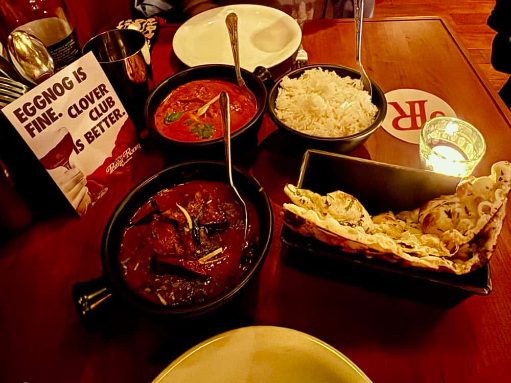
JAMAICA: Curry Goat
Another iconic Jamaican dish that is serve Peixe Grelhadod almost everywhere on the island. Curry was introduced to Jamaica by Indian immigrants who came to work on the sugar plantations. It quickly grew to become an inseparable part of the country’s culinary landscape.
Different from traditional curry, Jamaican curry is heavy with allspice and packs a spicy wallop on the palate. When slowly simmered with goat meat, the brisket soaks up the aroma of the spice and becomes succulent enough to slide off the bones — a perfect foil for steamy bowls of rice and peas.
PORTUGAL: Pastel de Nata
Portugal’s famous egg custard tart, in fact the mother of all custard tarts, Pastel de Nata doesn’t just have a continental standing but a global one. Sent all over the world, the best have lemon juice squeezed through their custard and a little nutmeg sprinkled upon their glossy film of a lid. Pastel de Nata has a rich history dating back to the 18th century in Lisbon.
Spain's jamon, or cured ham, is pretty legendary and you’ll see legs of salty jamon hanging at market stalls and on restaurant and bar menus all across the country. There are two types of jamon – serrano from white mountain pigs and Iberico from black Iberian pigs. You can eat slices of plain jamon on fresh bread as a snack or as part of a cheese board washed down with a glass of sherry.
Icelandic Happy Marriage Cake (Hjónabandssæla)
Hjónabandssæla – which translates to Marriage Bliss – is a simple but good everyday cake. It is straightforward to make, which adds to its popularity. Hjónabandssæla has its origins in the Austrian Linzertorte but has changed considerably through the decades, and it can be said that Hjónabandssæla has become unique to Iceland. It is important not to bake it for too long because it can become chewy – but if you like chewy cakes, you just do what you feel like!
Churrasco: Rio de Janeiro
For meat lovers visiting southern Brazil, eating at a churrasqueria is an authentic experience. This dish features skewered and grilled meats over an open flame, with picanha, linguiça, and frango as must-try cuts in Brazil, including beef, pork, and chicken. Local churrasquerias are the best option to try these, as the all-you-can-eat rodizio format is pretty popular and you usually spend less than when trying each cut on its own.
Sate Padang is such a unique (and delicious) type of Indonesian sate that I had to include it in this food guide as its own. Originally from Padang, a food lovers province on the west coast of Sumatra, Sate Padang seems to have a cult following among food lovers – and after I had my first plate, I completely understand why.
The skewers of meat, which often include beef pieces, beef tongue, and offal, are first marinated in a mixture of spices, then grilled over hot flaming charcoal, and finally they are often served over sliced up compressed rice cake, called ketupat, and then covered in a thick brown colored sauce, and sprinkled with crispy shallots. The result of Sate Padang is not the prettiest dish you’ll ever see, but the taste is incredible.
COLOMBIA: EMPANADAS
Empanadas are one of the most popular Colombian snacks, and you can buy them just about anywhere (even frozen ones in supermarkets). The best ones I tried were homemade on a farm in Buga, north of Cali – covered in homemade ají (Colombian-style hot sauce). They were so good I filled up on them, before realising they were only a snack before our three-course meal. Oops.
Empanadas come from the Spanish word “empanar”, which means to wrap or coat in bread. Basically empanadas are like a small pasty which is baked or fried. The crust is made with corn masa, while the filling is made with meat, potatoes and spices. The flavours vary depending on the region though. For example, in Medellin chorizo-filled empanadas are extremely popular, while in poorer areas they can be filled with cheese and spinach.
TURKEY: EZOGELIN CORBA
According to legend, this dish was dreamed up by an unhappily married woman named Ezo who was trying to win over her mother-in-law via her stomach.
She concocted a zesty soup consisting of red lentils, domato salca (tomato paste — sweet or hot), grated fresh tomatoes and onions, served with dried mint and pul biber (chili flakes) sprinkled on top.
There’s no proof it actually worked, but just in case, ezogelin (which literally translates to bride Ezo), originating from a small village near Gaziantep, is still the food of choice for brides-to-be.
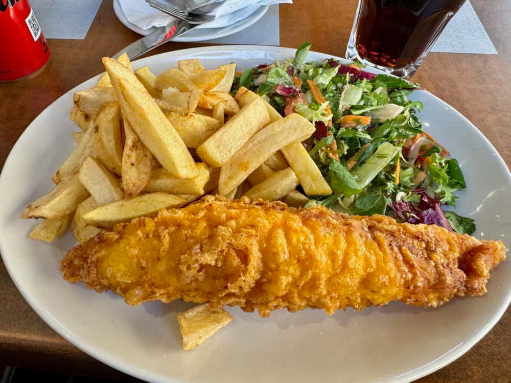
With no part of England more than 80 miles from the coast, so it only makes sense that Brits would know how to make some tasty seafood! The Brits’ penchant for fish and chips is the perfect case in point.
This simple meal of battered fried fish served on a bed of chips, aka French fries, usually comes with tartar sauce, malt vinegar, and a wedge of lemon. Cod or haddock are frequently used for the fried fish component, but other fish options can include halibut, hake, skate, pollock, and plaice.
You’ll often have a small side dish of green goop hanging out on your plate of fish and chips. These are mushy peas! (No, the kitchen didn’t mash up a bunch of green garden peas.) This unique side uses dried marrowfat peas that have been reconstituted and then cooked into a paste. They might look like something a toddler would create with Play-doh, but don’t knock ’em until you try ’em; they’re quite tasty!
UK: Chicken Tikka Masala
What’s the most British dish you can try in England? Believe it or not, many folks say it’s Chicken Tikka Masala.
One result of Britain’s nearly 200-year occupation of India is a deep love of curries, dals, tandoori, and other Indian delicacies. Brits returning from India put their own spin on the food they’d grown to love. One happy result of those experiments is chicken tikka masala which features yogurt marinated chicken, tomatoes, Indian spices, and cream.
Indian restaurants are ubiquitous in London and greater England. Bradford in West Yorkshire is considered England’s curry capital. Once a textile mill city, Bradford once attracted many immigrants. Although the mills are long gone, some 200 curry houses remain.
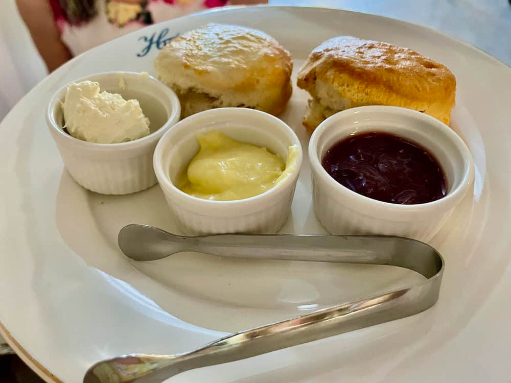
UK: Scones With Clotted Cream
Scones are basically just a baking powder biscuit, but they’re lightly sweet and have a lower fat content. Unlike North American scones which we frequently cut into wedges and shove full of additions like chocolate, berries, cheese, or herbs, British scones are always round. The only additions you can expect in British scones are some currants.
You can find scones all over in the British Isles; at bakeries, in grocery stores, and of course, as a staple on a British tea tray. For the most delicious way to enjoy a scone, indulge in the English tradition of cream tea, which is popular afternoon pick-me-up.
FISH & CHIPS
Fish and chips are the best-known British meal. When you’re in the mood, a piece of lightly-battered fish and a pile of chips hits the spot, especially if, like me, you come from the North of England where the lardy smell of a chip shop hits you from five streets away.
Anyway, in the 1800s, Portuguese/Spanish immigrants started selling fried fish. Fish and chip shops started opening. The rest is history.
This was a working class meal. We’re an island, so fish was plentiful and potatoes were cheap as chips (sorry). Families often had fish and chips once a week, eating them out of their newspaper wrappings.
The Mongolian Death Worm's native name, Olgoi-Khorkhoi, means "intestine worm" due to its red, blood-like color and size, which is the size of an intestine. It has been described by many people as being from 2-7 feet long and having the ability to spit out a corrosive yellow saliva and to generate blasts of electricity. However this latter power is thought of as being folkloric by the nomads of the Gobi. Western culture has come to call this monster the "Mongolian Death Worm".
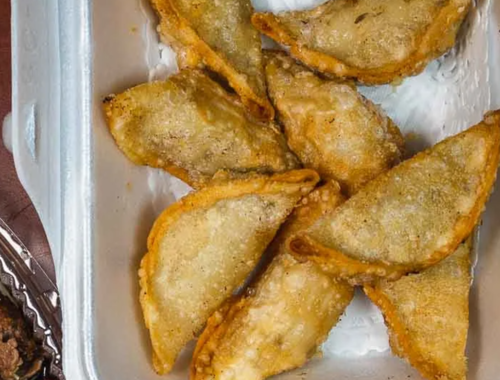
Gyoza are Japanese dumplings filled with minced pork, cabbage and garlic, and usually served with dipping sauce. You can enjoy this traditional Japanese food steamed and boiled, but it commonly enjoyed pan-fried to make the skin crispier.
Gyoza is widely available as appetizers in restaurants, or as street food snacks from food stalls and vendors. Aside from the thickness of the gyoza skin, garlic is a key component so a strong garlicky flavour sets it apart of Chinese dumplings.
Papua New Guinea: Mumu
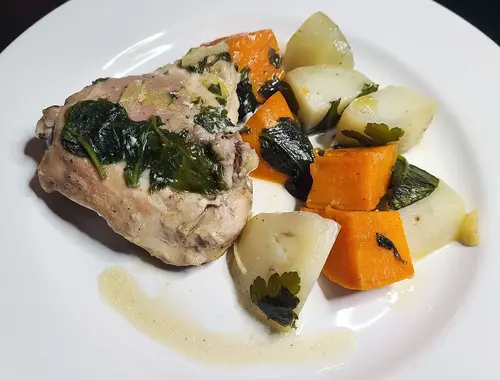
Mumu is traditionally cooked in an earth oven filled with hot stones. Pork, chicken, and various vegetables are wrapped in banana leaves and buried among the hot stones until done. Since I don’t have an earth oven, I used a regular oven instead and wrapped the ingredients in foil instead of in banana leaves. I consider this a rather loose interpretation of the dish.
I wrapped chicken thighs in one foil parcel and a combination of sweet potato and regular potato in another. I added spinach, parsley, salt, pepper, garlic, and coconut milk to each parcel. The recipe called for ‘seasonal market greens’ and ‘seasonal herbs’ so spinach and parsley are what I went with.
Next all I had to do was roast everything in the oven until done. I gave the chicken a head start so that it was falling off the bone by the time the vegetables were tender.
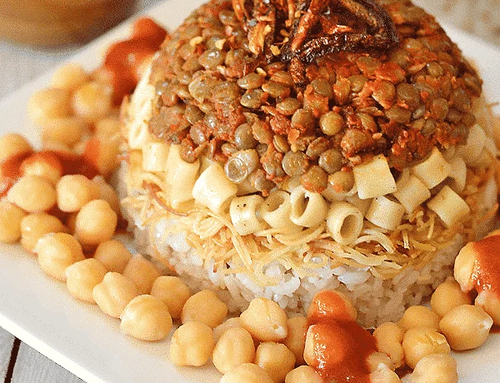
EGYPT: Koshari
Koshari or Kushari is Egypt's beloved street food. Essentially it is a bowl of comforting Rice, Pasta, Brown Lentils and Chickpeas that is drenched with a rich, spiced Tomato Sauce, a second sauce known as Kamouneyah or Dukka (a Cumin and Garlic Sauce) and fried savoury crispy Onions. Similar-ish to Mujadara, this recipe uses pantry staples.