Swimming the bounding main high on cocaine, Casey Salmon you better watch your speed. (You are what you eat)

Admin.

60k+⚡Milestone
Reaction score
17,696
Location
Weissnichtwo
Strange but true: salmon on cocaine swim a lot more.

But they’re not doing lines in the bathroom—they’re part of a new study. This sounds like an odd thing to research, but cocaine and its metabolites—along with other
Please, Log in or Register to view URLs content!
, mainly from human wastewater. And scientists are working to understand how such substances might affect wildlife.


“Many aquatic organisms in human-impacted environments are living in a dilute cocktail of biologically active chemicals,” says Jack Brand, a researcher in aquatic ecology at the Swedish University of Agricultural Sciences. “We’re only really scratching the surface.”

In the new study, Brand and his colleagues focused on wild Atlantic salmon (Salmo salar). The team fitted 105 juvenile salmon reared in captivity with an acoustic tracking tag and an implant. In one group of 35, the implant slowly released cocaine, in another it released benzoylecgonine (cocaine’s main metabolite), and in a control group it released nothing. They then released the salmon into Lake Vättern in Sweden to see what happened .

Please, Log in or Register to view URLs content!
 

MANCID RILKO

30k+⚡Milestone
Reaction score
4,553
Location
In a kakistocracy
"Rachel Ann Hauser-Davis, a biologist at the Oswaldo Cruz Foundation in Brazil, who wasn’t involved in the research, says that the study was an important step forward because previous research had only been conducted in laboratory settings. But she notes that slow-release implants don’t perfectly mimic how a fish might encounter contamination in the water naturally."
 
OP
OP
Admin.

Admin.

60k+⚡Milestone
Reaction score
17,696
Location
Weissnichtwo

Oregon gray whale strandings raise alarm of die-off​


Nearly two dozen
Please, Log in or Register to view URLs content!
have washed ashore along the West Coast this year, including three found on Oregon beaches — a troubling sign some experts say may signal another die-off event.
The big picture: Many of the whales appeared upon necropsy to be emaciated, meaning
Please, Log in or Register to view URLs content!
during last summer's feeding session, Michael Milstein, a spokesperson with the National Oceanic and Atmospheric Administration, told
Please, Log in or Register to view URLs content!
.


  • "If we're seeing this many whales that are undernourished and having trouble this early in the year, what is that going to mean for the rest of the migration?" he said. Gray whales travel roughly 12,000 miles from Mexico to Arctic feeding grounds yearly.
The latest: Last week, two whales — a 40-foot gray whale and a Baird's beaked whale — were discovered on
Please, Log in or Register to view URLs content!
and southwest Washington's
Please, Log in or Register to view URLs content!
.
  • Another juvenile gray whale died earlier this month after being found swimming in Washington's Willapa River,
    Please, Log in or Register to view URLs content!
    .
Flashback: Between 2019 and 2023, gray whale numbers fell from roughly 27,000 to 13,000 in what biologists called
Please, Log in or Register to view URLs content!
, driven by ecosystem changes in Arctic feeding grounds that disrupted food supplies and led to widespread malnutrition and deaths.
  • Please, Log in or Register to view URLs content!
    , driven by human-caused climate change, leads to less available algae and crustaceans, leaving more whales undernourished.

This spring's early strandings suggest gray whales are again under severe stress, having been spotted feeding in places outside the species' typical sources, putting them more at risk, Milstein said.
  • For example, several gray whales foraging in the San Francisco Bay this month have died after being
    Please, Log in or Register to view URLs content!
    .


Please, Log in or Register to view URLs content!
 
OP
OP
Admin.

Admin.

60k+⚡Milestone
Reaction score
17,696
Location
Weissnichtwo

Loss of whales means a hotter, more dangerous planet​

Whales are under threat — along with the important climate-regulating services they provide​


Last year, a beloved orca named Lolita passed away after five decades in captivity at the Miami Seaquarium. Lolita’s death sparked conversations about the harms inflicted by capturing these magnificent creatures. But few noted the much greater threats to Lolita’s counterparts in the wild — and, by extension, to all of us.

On land and sea, the planet is overheating. Last summer was the
Please, Log in or Register to view URLs content!
in Miami; ocean temperatures off the Florida coast
Please, Log in or Register to view URLs content!
. As temperatures rise, there is a growing imperative to reduce emissions to mitigate climate change impacts.

In the intricate balance of Earth’s climate system, the oceans emerge as vital player. Comprising
Please, Log in or Register to view URLs content!
, the oceans absorb
Please, Log in or Register to view URLs content!
of the surplus heat generated by greenhouse gas emissions and sequester approximately
Please, Log in or Register to view URLs content!
. How do the oceans accomplish this feat? By providing a home for lots of microscopic phytoplankton.

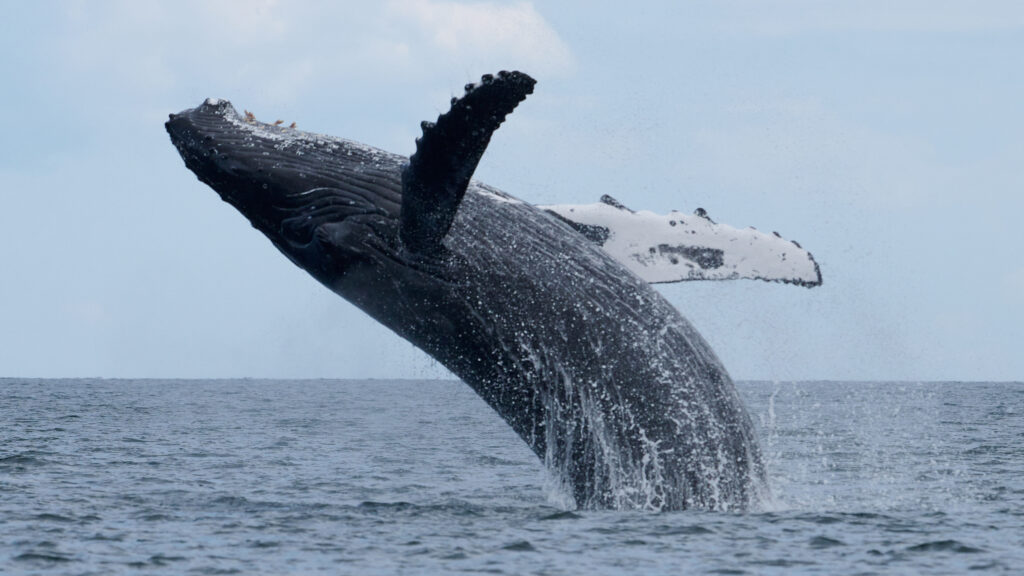
A humpback whale jumping out of the water (iStock image)
Through photosynthesis, phytoplankton
Please, Log in or Register to view URLs content!
from the atmosphere and convert it into organic carbon, thus reducing greenhouse gases. To increase the number of phytoplankton, we turn to one of the largest animals in the ocean, the whale.

Whales feed in the deep ocean, then surface to defecate, releasing nutrients like nitrogen, iron and phosphorus that serve as food for phytoplankton. And, when whales die, they
Please, Log in or Register to view URLs content!
, effectively removing climate-changing greenhouse gases from the atmosphere for long periods. This system is known as the “whale pump” or the “whale conveyor belt.”

rla Santoyo
Sadly, whales, and the important climate-regulating services they provide,
Please, Log in or Register to view URLs content!
. From entanglement in fishing gear to vessel strikes and ocean noise, some species (including the North American right whale) are in danger of extinction.

For example, noises from shipping vessels and other craft disorient the animals, preventing them from finding food and mates, which decreases their chance of survival. There are currently no international standards to regulate noise in the ocean.

Losing Lolita was sad, but losing wild whales — and their benefits for the climate — means a hotter, more dangerous planet. In addition to deadly storms, droughts and wildfire, climate change poses enormous
Please, Log in or Register to view URLs content!
. Rising temperatures have been linked to respiratory and cardiovascular diseases, vector- and tick-borne illnesses, fungal infections and more. Climate change can indirectly impact health through its effects on agricultural productivity and food security, air quality and risks to health care infrastructure.

By understanding the role of whales in mitigating climate change, we can become informed advocates for ecosystem conservation. Whether it is through spreading knowledge or advocating for policies that protect biodiversity, let us speak up and make a difference. At the same time, we can actively fight climate change by planting trees, riding bikes, reducing food waste, using energy-friendly household appliances and voting for candidates who support green energy initiatives.

We urge health care providers to help address these challenges, by spreading the word among physicians, promoting climate-resilient health care practices and providing care to communities affected by climate-related health threats. After all, a healthy planet benefits not just the whales, but all of us. Let’s be the change.

Karla Santoyo and Raghuram Reddy are both second-year medical students at Florida International University’s Herbert Wertheim College of Medicine. The views represented in this opinion piece are their own and do represent the views of their institutions


Please, Log in or Register to view URLs content!
 

LotusBud

30k+⚡Milestone
Reaction score
9,607
Location
Portugal

Loss of whales means a hotter, more dangerous planet​

Whales are under threat — along with the important climate-regulating services they provide​


Last year, a beloved orca named Lolita passed away after five decades in captivity at the Miami Seaquarium. Lolita’s death sparked conversations about the harms inflicted by capturing these magnificent creatures. But few noted the much greater threats to Lolita’s counterparts in the wild — and, by extension, to all of us.

On land and sea, the planet is overheating. Last summer was the
Please, Log in or Register to view URLs content!
in Miami; ocean temperatures off the Florida coast
Please, Log in or Register to view URLs content!
. As temperatures rise, there is a growing imperative to reduce emissions to mitigate climate change impacts.

In the intricate balance of Earth’s climate system, the oceans emerge as vital player. Comprising
Please, Log in or Register to view URLs content!
, the oceans absorb
Please, Log in or Register to view URLs content!
of the surplus heat generated by greenhouse gas emissions and sequester approximately
Please, Log in or Register to view URLs content!
. How do the oceans accomplish this feat? By providing a home for lots of microscopic phytoplankton.

A humpback whale jumping out of the water (iStock image)
Through photosynthesis, phytoplankton
Please, Log in or Register to view URLs content!
from the atmosphere and convert it into organic carbon, thus reducing greenhouse gases. To increase the number of phytoplankton, we turn to one of the largest animals in the ocean, the whale.

Whales feed in the deep ocean, then surface to defecate, releasing nutrients like nitrogen, iron and phosphorus that serve as food for phytoplankton. And, when whales die, they
Please, Log in or Register to view URLs content!
, effectively removing climate-changing greenhouse gases from the atmosphere for long periods. This system is known as the “whale pump” or the “whale conveyor belt.”

rla Santoyo
Sadly, whales, and the important climate-regulating services they provide,
Please, Log in or Register to view URLs content!
. From entanglement in fishing gear to vessel strikes and ocean noise, some species (including the North American right whale) are in danger of extinction.

For example, noises from shipping vessels and other craft disorient the animals, preventing them from finding food and mates, which decreases their chance of survival. There are currently no international standards to regulate noise in the ocean.

Losing Lolita was sad, but losing wild whales — and their benefits for the climate — means a hotter, more dangerous planet. In addition to deadly storms, droughts and wildfire, climate change poses enormous
Please, Log in or Register to view URLs content!
. Rising temperatures have been linked to respiratory and cardiovascular diseases, vector- and tick-borne illnesses, fungal infections and more. Climate change can indirectly impact health through its effects on agricultural productivity and food security, air quality and risks to health care infrastructure.

By understanding the role of whales in mitigating climate change, we can become informed advocates for ecosystem conservation. Whether it is through spreading knowledge or advocating for policies that protect biodiversity, let us speak up and make a difference. At the same time, we can actively fight climate change by planting trees, riding bikes, reducing food waste, using energy-friendly household appliances and voting for candidates who support green energy initiatives.

We urge health care providers to help address these challenges, by spreading the word among physicians, promoting climate-resilient health care practices and providing care to communities affected by climate-related health threats. After all, a healthy planet benefits not just the whales, but all of us. Let’s be the change.

Karla Santoyo and Raghuram Reddy are both second-year medical students at Florida International University’s Herbert Wertheim College of Medicine. The views represented in this opinion piece are their own and do represent the views of their institutions


Please, Log in or Register to view URLs content!
OMG OMG OMG :SadFace:
 
OP
OP
Admin.

Admin.

60k+⚡Milestone
Reaction score
17,696
Location
Weissnichtwo
"Rachel Ann Hauser-Davis, a biologist at the Oswaldo Cruz Foundation in Brazil, who wasn’t involved in the research, says that the study was an important step forward because previous research had only been conducted in laboratory settings. But she notes that slow-release implants don’t perfectly mimic how a fish might encounter contamination in the water naturally."
Emaciated whales are washing up on the beaches the beaches at pace not seen before.